
— UNDERSTAND · NAVIGATE · GROW · TOGETHER
Find your bearings in unfamiliar waters.
Maria Pitale, Psy.D. offers neurodiversity-affirming neurodevelopmental assessment, and support groups for caregivers and siblings.
— BENEATH THE SURFACE
Calmer waters begin with deeper understanding
Parents often arrive after weathering confusing diagnoses, conflicting advice, difficult school meetings, and moments of anxiety and uncertainty.
Behavior gives us information, but it does not tell the whole story. The same action can come from many different sources: different sensory needs, emotions, sensory experiences, relationships, or attempts to feel safe. My role is not to take over the helm. It is to listen, stay curious, and help your family recognize the currents beneath the surface.
| Together we’ll navigate what comes next.
A clearer course for your family.
— HOW I HELP
Each service begins with the child or family in front of me—not a predetermined route or a one-size-fits-all map.
02 · CAREGIVER SUPPORT GROUP
A place for parents to feel understood
Connection either with me or other parents navigating a different kind of parenting journey - without judgment, simple fixes, or the expectation that you should have it all figured out.
01 · NEURODEVELOPMENTAL & AUTISM ASSESSMENT
Understanding - not a list of deficits
A collaborative, strengths-aware evaluation designed to make sense of your child’s individual profile. The report becomes a practical roadmap for understanding, accommodations, and advocacy.
03 · SIBLING SUPPORT GROUP
Space for siblings’ experiences, too
A supportive setting where siblings can connect, express what family life feels like for them, and make room for their own needs and perspectives.
—APPROACH
Guided by relationship.
Grounded in understanding.
Neurodiversity-affirming care does not ignore distress. It helps us understand the waters that your child is navigating — and refuses to frame the person as something to fix.
The child has a voice
Children are participants in their care, not simply subjects discussed by adults.
Felt safety comes first
Sensory needs, pacing, environment, and relationships matter before meaningful work can happen.
Parents are partners
You bring lifelong knowlege of your child. I bring clinical experience. We need both to find the way forward..
Advocacy is part of care
Understanding should lead to useful accommodations, stronger self-advocacy and practical next steps.
— MEET MARIA
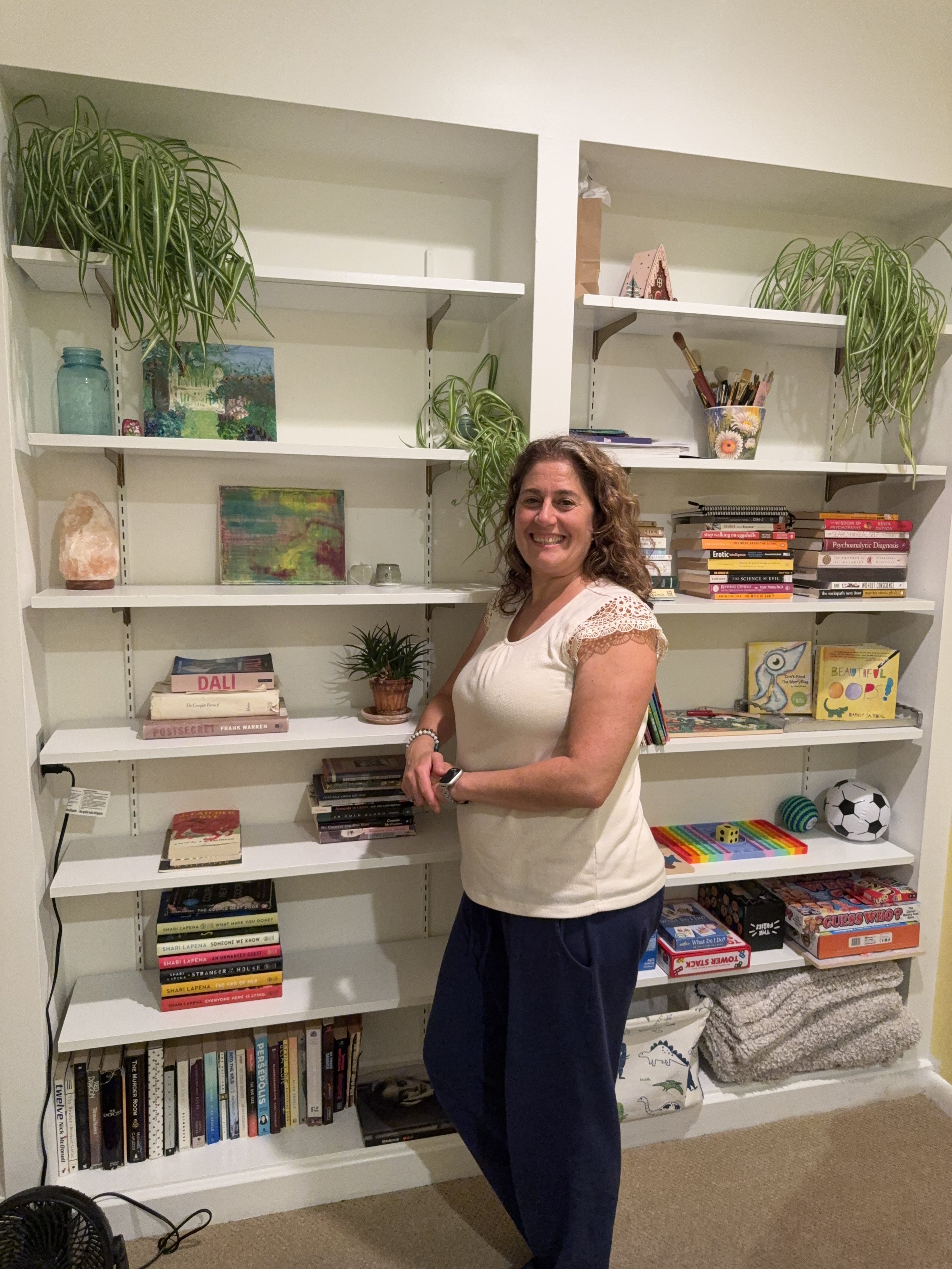
I am a licensed neurodivergent psychologist, a parent of neurodivergent children, an advocate, a resource finder, and a person who believes humor belongs in hard rooms.
Meet Maria- a genuine connection starts here.
Across more than 20 years in clinical, school, and research settings, I have learned that children who are most misunderstood do not need a focus on compliance, consequenes, or a stricter manual. They need adults curious to wonder what’s happening beneath the surface.
Parenthood made that understanding personal. I know what it is like to navigate systems, search for the right support, advocate at school, and worry about what comes next. That experience keeps me humble about what professional expertise can —and cannot —tell us on its own.
The synergy of my professional and personal experiences as a bilingual psychologist and graduate of Widener’s doctoral program, has helped me recognize the importance of what is happening with the underlying current for the child, in addition to observable factors impacting the child and family.
It is my aim to help the family and child to look inward and embrace the value of understanding the inner compass experience. This can help us to guide the child and family back to a place where they feel more regulated and ready to move forward.
When we understand what’s underneath, we can support what comes next.
— A BIT ABOUT ME
Authentic relationships are part of the work.
I believe healing happens through authentic relationships. When you meet me, you’ll meet a licensed psychologist with years of experience, but you also will meet the same Maria I bring to everyday life: curious, compassionate, genuine, and fully present.
The importance of values based care.
Providing values-based care keeps my practice aligned with how I want to provide care. It also helps me build a robust network of options for caregivers who are parenting a child who is following their own map rather than the one their parents are trying to use.
These families recognize that by integrating the input from their child this helps them to plot their own course as they co-create their own new map which allows them to move forward.
Not all children learn best in traditional school settings.
The world needs all kinds of brains, yet public school often does not know how to support them.
For families choosing an alternative learning journey, taking an individualized path can shift a child from distress and struggling to flourishing.
My connection with Jacob’s Ladder is a personal one, and I am so thankful for their ability to connect and meet my child where he was. Their affirming approach to connecting with children in nature helped me feel hope. I am eternally thankful for their support and to have a child-centered option to recommend for caregivers.

Providing a better way.
The focus within schools on observable behavior, compliance, and consequences has the potential for harm to children and educators, especially when there is the use of seclusion and restraint.
I am proud to be one of the inaugural members of EndSarNJ as the Lead on the Parent committee initially as a volunteer, and now a Board Member.
Surrounded by a group of passionate professional women, we are committed to keeping students and educators safe.
In my role on the Parent Committee, as a volunteer, I provide free confidential support to caregivers whose children have experienced seclusion and restraint in a monthy support group on the second Friday of the month from 7-8 pm. Individual support is also available. We are here to support you. Please reach out if we can support you in some way.

Training, frameworks, and values I draw from.
— APPROACHES THAT GUIDE MY WORK
Tina Bryson and Play Strong: Play Therapy, Interpersonal Neurobiology and Neurodiversity Conference: An Interdisciplinary Approach to Treatment with the Brain in Mind
— WHAT CARE CAN LOOK LIKE
Every journey begins by finding your bearings.

Your child’s inner compass offers direction. Together we will navigate what comes next.
Beginning in the least stressful way
That might mean starting virtually, visiting the office informally, or letting your child see the space before being asked to participate.
Making room for sensory needs.
We can consider lighting, smells, movement, comfort objects, breaks, and other details that help the nervous system feel safer.
Adjusting the course as your child guides us
If your child does not have the spoons that day, we can slow down, shift focus, or find another way forward
Offering choices without overwhelm
I share a thoughtful range of resources and options— a buffet not a mandate-at a pace that feels manageable for your family.
—EXPLORING A LENS SHIFT
Useful resources for a lens shift.
I am always interested in learning from others who embrace a neuro-affirming approach to care. Below are some of my favorite people, podcasts, books, and websites that feed my curiosity, align with how I practice, and influence how I provide care.
Diane Gould, LCSW, PDA North America
Kristy Forbes, Educator, Advocate, Intune Pathways
Ross Greene, PhD, clinical child psychologist, Collaborative and Proactive Solutions
Mona Delahooke, PhD, pediatric psychologist, Beyond Behaviors
Dan Siegel, MD, Interpersonal Neurobiology
Tina Payne Bryson, PhD, psychotherapist The Play Strong Institute, The Center for Connection
Lisa Dion, LPC, RPT, Synergetic Play Therapy
Greg Santucci, OT, Power Play Pediatric Therapy
Kelsie Olds, OT, The Occuplaytionalist
Kelly Mahler, OTD, OTR/L, FAOTA, an occupational therapist, Interoception
Linda Murphy, MS, CCC-SLP, Declarative Language and Co-Regulation
“Em” Emily Lowery, speech therapist, Neurowild, amazing affirming cartoons
Jacquelyn Fede, PhD, autistic advocate and developmental psychologist, Autism Level Up
Amy Laurent, Ph.D., OTR/L, a developmental psychologist and a registered pediatric occupational therapist, Autism Level Up
Laurie Desautels, Assistant Professor, Applied Educational Neuroscience
Affirming Professionals
Podcasts
Books
The Explosive Child
Declarative Language Handbook
Co-Regulation Handbook
Uniquely Human
The Whole Brain Child
No Drama Discipline
Beyond Behaviors
Brain-Body Parenting
Unconditional Parenting
Different Not Less
Me and My PDA
Navigating PDA in America
The Educator’s Experience of Pathological Demand Avoidance
Life on an Alien Planet
Your Child's Point of View: Understanding the Reasons Kids Do Unreasonable Things
The Kids Guide to Staying Awesome and In Control
Programs and Frameworks
— FREQUENTLY ASKED QUESTIONS
Questions families often bring.
A few practical details before reaching out.
-
I work with toddlers through young adulthood wth a focus on neurodivergent and neurodevelopmental children, teens, young adults, and their families.
-
I offer neurodevelopmental and autism assessment, caregiver support groups, and sibling support groups.
I also provide consultation services to professional and agencies interested in applying a neurodiversity-affirming lens to the work they do and services they provide.
-
In-person services are available in Media, Pennsylvania. Virtual services are also available. Appointments can be scheduled at mutually convenient times.
-
Yes. My work is neurodiversity-affirming and grounded in understanding the child’s inner experience, not just what shows on te outside. I have particular expertise supporting families navigating trauma, autism, PDA, anxiety, and othr neurodevelopmental differences.
-
It means that I value all brains as valid neurotypes. It also means meeting the person in front of me with curiosity, flexibility, and respect. Care is collaborative, relationship-based and focused on building understanding, providing support for who the person is, accommodation, advocacy, and felt safety.
-
Step 1: Assessment starts with an intake session that can be done in an individual session or several sessions based on caregiver's need to attend to the child and own personal needs.
Step 2: Assessment includes completion of several measures sent digitally to caregiver and young person.
Step 3: When indicated, in person testing occurs over 1-3 sessions lasting several hours each. Pacing for assessment is determined by child's nervous system regulation needs.
Step 4: Review of any collateral documentation and speaking with collateral professionals when clinically indicated.
Step 5: Completion of a written report and feedback session with caregiver and child.
-
No. Many parents find caregiver consultation, and support groups to be helpful with parenting without involving their child.
Your child would need to be involved in assessment, but the process could be adjusted to your child’s needs.
-
The groups are designed for caregivers to have a safe place for parents to be understood. The groups are open to step-parents, kinship parents, foster parents, and other caregivers who play a significant role in caring for the child. Blood relationship to the child is not required.
-
I do not acccept insurance. My services are private pay. I can provide a superbill to submit for possible out-of-network reimbursement. I also have a limited number of sliding scale spots to help with accesibility.
-
My hourly rate is $175 per hour.
Neurodevelopmental and autism assessments are a flat $2500 fee.
Price for assessments for other reasons are determined prior to proceeding based on complexity of referral question.
Groups range from $25 to $0 per session.
-
I have worked with a focus on children from infancy through early adulthood since 1993 and working in the field of psychology since 1997. This has included developmental research with Drexel University and Robert Wood Johnson looking at the impact of mother substance usage in utero and the impact of maltreatment and poverty on children’s development in longitudinal research.
I was the Quality Assurance Coordinator for a survey study of Hispanic individuals across the USA with Temple University. I have also worked on NIH funded research at the Drexel Autism Center examining to examine the efficiency of certain medications for autistic children.
Educationally, I obtained my BA from Gettysburg in Psychology and Spanish. I received my Masters of Arts and Doctorate in Psychology from Widener University. I also completed several courses in a health-focused MBA program.
Clinically, I have worked in outpatient community mental health, private practice, residential, inpatient, dual-diagnosis drug and alcohol, and school settings. I have completed a range of assessments for individuals in the community mental health setting including level of care, Comprehensive Biopsychosocial Evaluation and Re-Evaluations, Psychological Evaluations, and evaluations to qualify and individual for placement in an inpatient facility. I have completed bilingual school psychological evaluations, consultations, and participation in Multi-Disciplinary Team meetings.
I was trained to complete autism evaluations at the Drexel Autism Center with Drs. Richard Malone, Susan Hyman-West, Ayesha Waheed, and Manely Ghaffari. While at Drexel, I helped to establish a clinic to assess Spanish-speaking clients across Philadelphia through an ASERT Grant. I was the inaugural psychologist at one of CBH’s Philadelphia Autism Center for Excellence where I have completed comprehensive diagnostic evaluations, supported families with advocacy, and facilitated a parenting psycho-education group and a social skills group for children.
-
The first step is to reach out. We can talk about what your family is looking for, whether my approach would be a good fit, and what the next step could look like.
-
Reach out via the contact link on the website with your questions. We can schedule a free 20 minute consultation to explore your questions and figure out next steps.
Have a question or
want to connect?
Send me a quick note about how you think I could help. I will get back to you within 2 business days.